AI Advisory · Six-Week Cohort Program · 2026
If you lead a go-to-market team, you have already asked the first question: “Where do we even start?” Your board or your CEO asks the harder one a few months later: “So was there any ROI?”
This is the story of a B2B software company’s go-to-market team, nine people and no engineers in the room, who answered the first question before they ever met me. The answer they gave me became the curriculum, the build list, and the proof their CRO can point to.
Before Session One · What the Team Told Me
The Team
Nine people across sales, SDRs, enterprise, customer success, marketing, RevOps, and leadership. Spread across five time zones. Leadership was pushing for AI adoption, and the comfort levels in the room ran the full range, from “haven’t really touched it” to “I’ve built Projects and Skills.”
The company had already put the whole team on an enterprise AI plan. The CRO wanted a team that could self-serve its own data without routing everything through RevOps, and the board was pushing for more AI adoption across the company.
There was never going to be a whiteboard day where everyone sat together and listed pain points. So the discovery had to happen before the first session, on each person’s own time.
The Pre-Work: One Short Form
Two weeks before kickoff, everyone got the AI Priority Finder, a small web app I built in Lovable. It asks one thing: name what eats your week. A few minutes per person, no meeting required. Then it walks you through four steps.
Capture. Pick a type of work and write the friction in a sentence. If you get stuck, open the sparks: six example frictions per work type, rewritten for this team’s world.
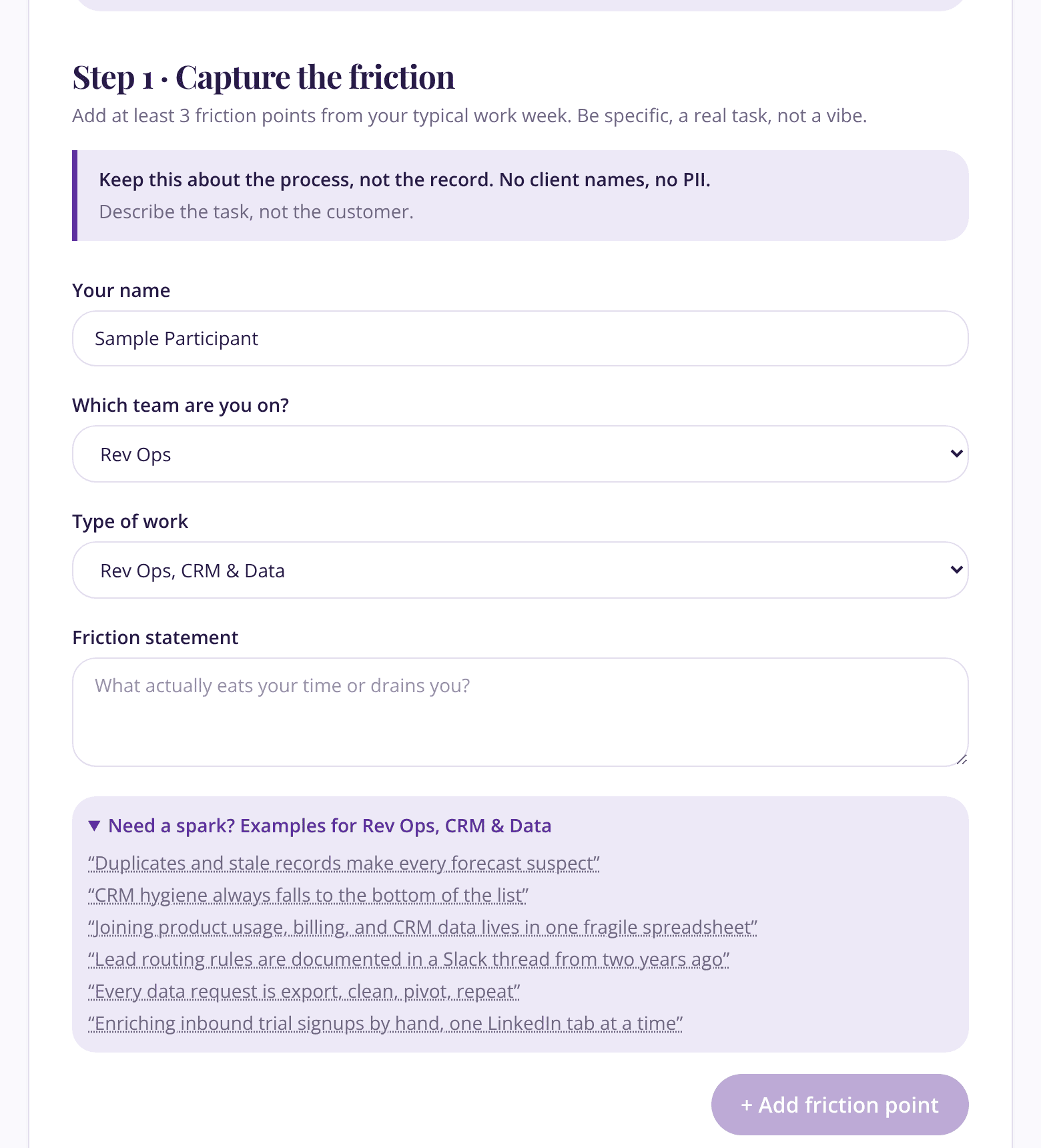
The capture step, with the sparks open
Score. Three sliders, one to five: how much time it takes, how much it would matter if it were fixed, and how well AI could handle it. Every number carries a sentence. A 3 on AI fit reads “AI drafts it, I polish it.” A 5 reads “Repetitive and rules-based. AI could crush this.” Nobody agrees what a 3 means. Everybody agrees on that sentence.
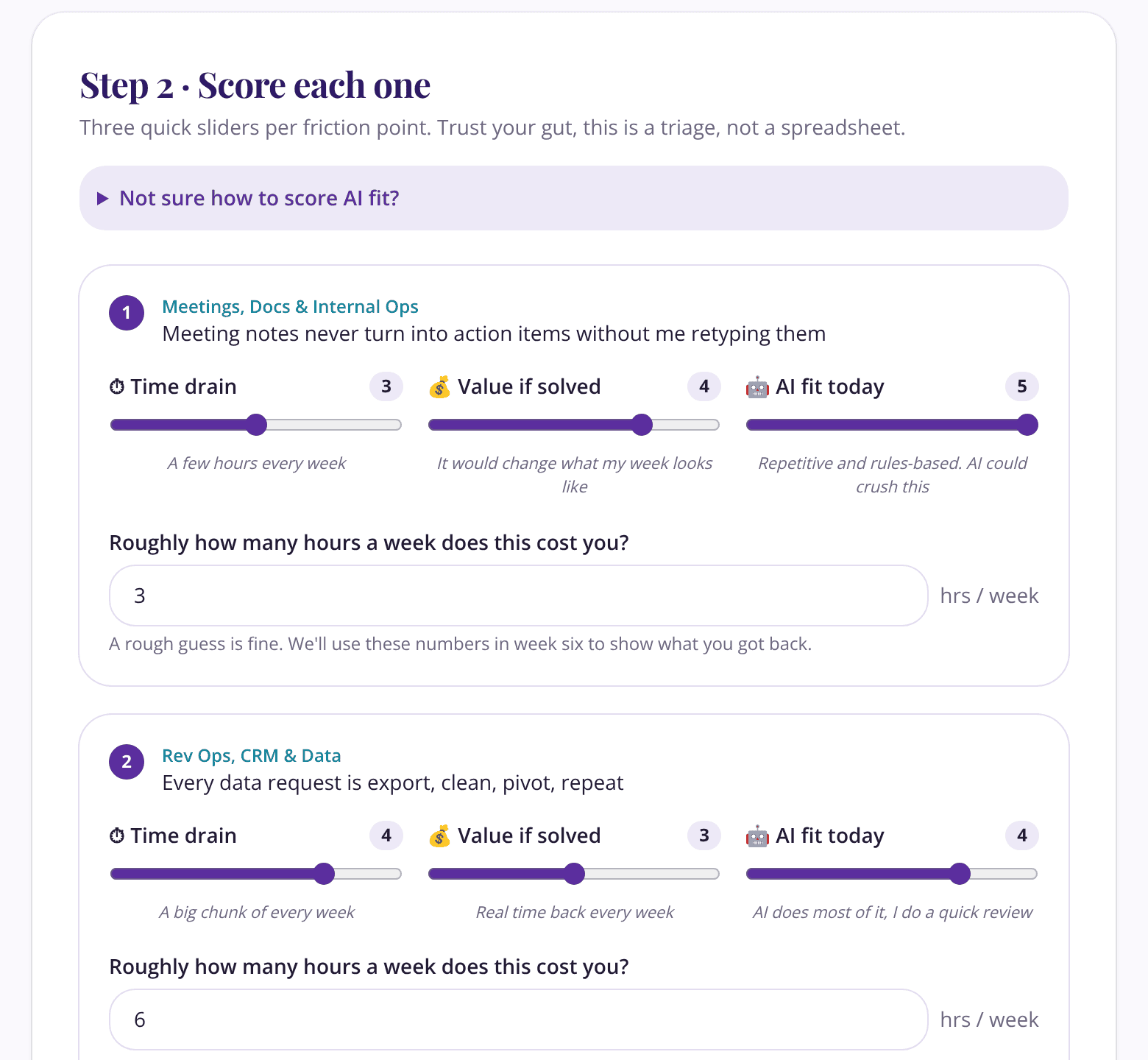
Every slider value gets a sentence, and an optional hours-per-week box becomes the baseline
Prioritize. The tool ranks everything on the spot with a visible formula: time × 1.0 + value × 1.2 + AI fit × 1.3. AI fit carries the most weight because a six-week program can only fix what AI can touch. Each item lands in a bucket: Quick Win, Sweetspot, Moonshot, or Later.
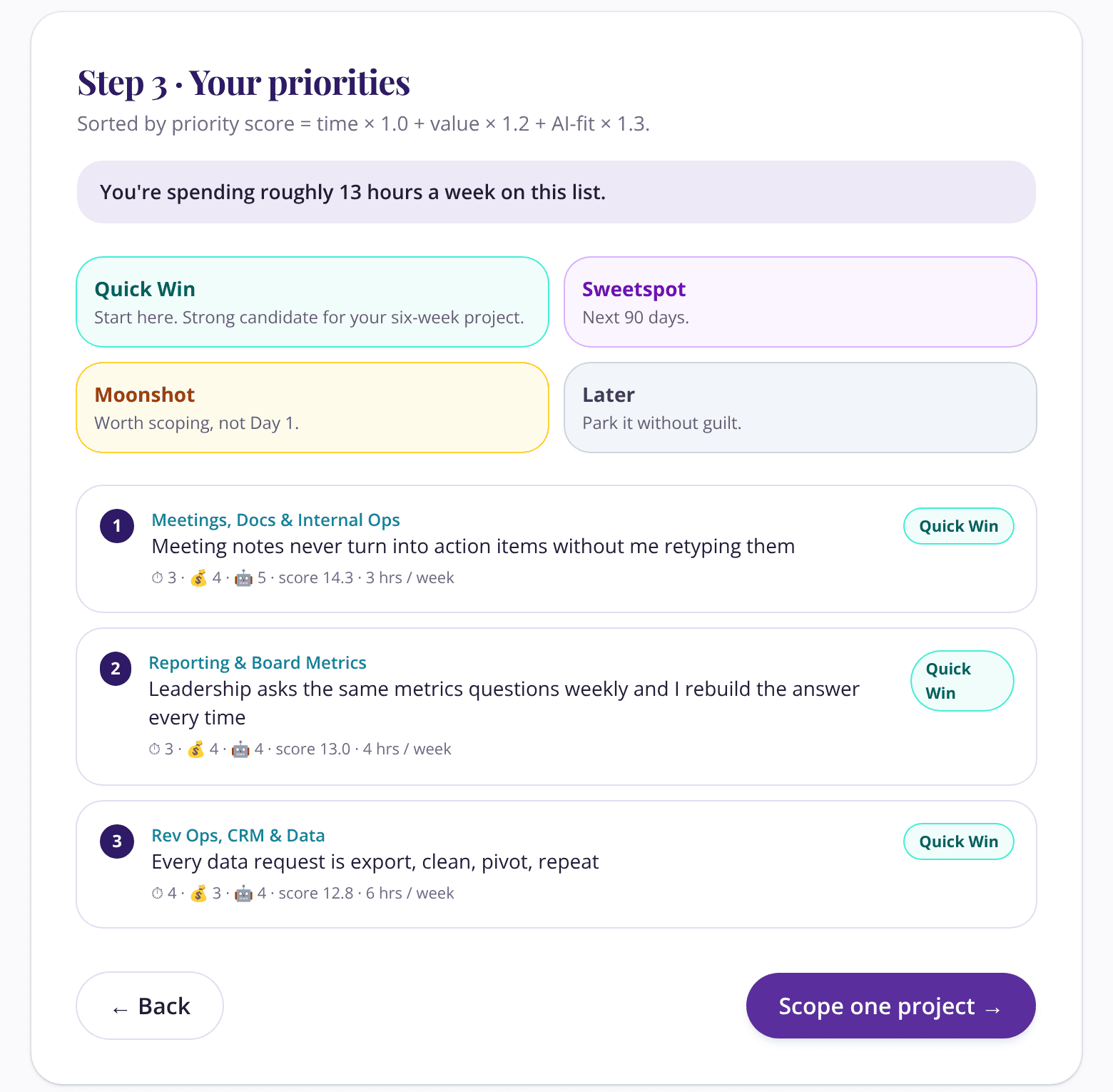
The ranked list, with the formula printed right at the top
Scope. Pick one item and answer a few questions about it. That item is usually what the person builds in the program.
What Came Back
Eight of nine people submitted before the first class. One reminder from their champion, a sales director inside the company, did more than any nudge from me could have. If you are the person bringing this to your team, that reminder is the most important thing you will do in the first two weeks.
They logged 37 friction points and 178 hours a week of combined drag. Those hours are self-reported estimates and some overlap, so I treat the number as a ranking tool and a baseline, never a payroll figure. Fourteen items landed as Quick Wins, and those fourteen held 99 of the 178 hours. More than half the drag sat in work AI could mostly do.
And the words were theirs. Twenty-eight of the 37 points were written from scratch. A few of my favorites:
“Most analysis today starts with someone handing me a spreadsheet to work through.”
“Process documentation never happens, so I am the process.”
“My biggest blocker? Not knowing where to start.”
Three things in the raw data shaped how I ran the program. The same friction showed up across teams: meeting commitments that never became action items came from sales and RevOps alike. Comfort bent the AI fit scores: the person newest to Claude scored everything a 5, and a self-described dabbler scored most items a 1. So we calibrated AI fit together in session one. And two people had submitted twice, so I cleaned the data before a single number went on a slide.
The List Became the Curriculum
Session one opened with their list, grouped into four themes: meetings that vanish, analysis that waits, one-size-fits-all output, and reporting you fight. The slide said it plainly: “This list is the curriculum now.” Every class after that was built from what they submitted, and the breakout tracks named each person’s candidate build.
Nobody checks email during a session about their own complaints.
What They Built
Over six weeks, every person in the cohort shipped something against a friction they had named before kickoff. If you run one of these functions, look for your own week below.
Marketing lead. Named campaign and webinar content as manual, about 15 hours a week. She built a webinar content calendar from past webinars, audience and seasonality, then started feeding Claude her webinar template and her strongest past decks. Designer ramp time on webinar decks went from four days to one or two. She also turned meeting transcripts into a launch tracker that resolves open items on its own.
RevOps lead. Named a flood of requests and constant fire drills. By week three she had a triage tool live that prioritizes, assigns, and routes every request, plus a searchable dashboard of the team’s board that anyone can see without a license. Duplicate requests stop at the door.
SMB sales lead. Named pipeline reviews with the AEs. She built a pipeline review rubric that flags deals as risky, close to lost, or needing action, then a dashboard that refreshes from a scheduled data pull every morning at 7:15. Version two is in the AEs’ hands, and most of them had no idea Claude could do this before she showed them.
Customer success. A CSM who wanted to reclaim about 20 hours a week of review prep built a success plan generator that gives every CSM the same one-page PDF. Her director built skills for the team and now requires them for repetitive work, then started coaching the CSM to use Claude for data analysis in place of manual spreadsheet work.
Enterprise. A morning briefing that pulls every external meeting, its attendees, and the last call notes, delivered by 8:30. A business case generator. And a monthly capacity check across enterprise accounts that flags which ones need an invoice change, with the prep math gone.
Closing the Loop
I did not re-run the form at the end. I did not need to. In the final class we ran lightning wins: ninety seconds each on one thing that runs without you, who uses it, and what you had to fix before you trusted it. The room knew what worked because the people in it had shipped it, and every win traced back to a line they had typed into the form in week one.
Then we handed back the rest of the list. The Sweetspots and the Later items became each person’s 90-day roadmap, the document leadership can measure against. People walked out with a list of things they now feel able to build on their own.
The CRO had asked for one thing in the first office hours: a team that could self-serve its own data without routing everything through RevOps. By the last office hours the pipeline review dashboard was in the AEs’ hands, the RevOps triage tool was routing requests, and she was folding Claude into her daily work and next year’s planning.
If you want hard before-and-after numbers for your board, the option is built in: the same form in week six, same items, new hours.
Where the Hours Go
The teams I work with are exhausted. Their to-do lists never end. This work is never about letting people go. It is about getting them out of the rote, boring tasks, like retyping meeting notes, export, clean, pivot, repeat, and rebuilding the same weekly metrics, and into the work they were hired for: customer conversations, coaching, strategy, and the next thing worth building.
Recover even a quarter of those 99 Quick Win hours and that is roughly 25 hours a week, or about 1,290 hours a year, back for higher-value work. Multiply that by your own loaded rate and the business case is yours: your team’s numbers, your team’s words, nothing I invented.
If You Are Bringing This to Your Team
Your team names the problem, so your team owns the fix. Asking what eats their week gets you tasks with hours attached. Asking what AI could do for them gets you a wish list. The first one is a curriculum, and nobody skips a class about their own complaints.
The examples come in your team’s language. Six real frictions per work type, written for your company before anyone opens the form, give people permission to be specific. I write them myself, for every client.
The baseline is theirs, so the ROI is too. When the hours come from the team, nobody argues with them in week one, and nobody has to invent the ROI story at the end. You know where you stand before the first class, and you can measure against it after the last one.
What it takes from you. One champion inside the company, a few minutes from each person, and the AI tools you already pay for. No engineers and no whiteboard day.
Want to see where AI could help your team first?
Try the free AI Priority Finder on your own week, see the six-week program this case study comes from, or tell me about your team and I will tell you whether this is the right fit.
Try the AI Priority FinderSee the Crys Clear AI for GTM ProgramBring It to Your Team